
Class 5 English Worksheet on Concrete and Abstract Words

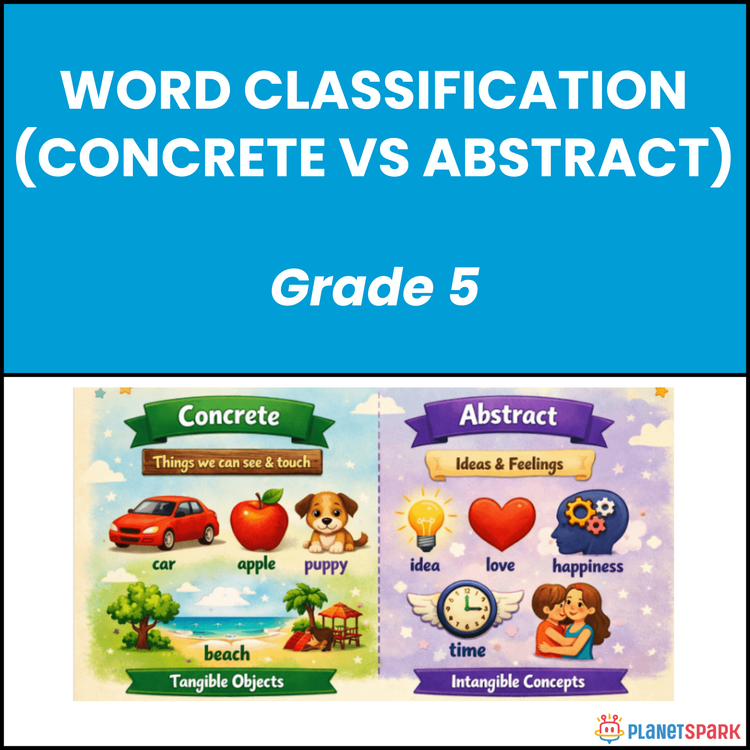
Class 5 English Worksheet on Concrete and Abstract Words
Invisible Ideas: Concrete and Abstract Words for Class 5
This Grade 5 English grammar worksheet helps learners understand the difference between concrete and abstract nouns through clear, age-appropriate grammar practice. Students explore how some nouns name things we can see or touch, while others name feelings, qualities, ideas, and states that we cannot physically hold. With engaging activities like multiple-choice questions, true or false, fill in the blanks, underlining abstract nouns, and passage completion, this worksheet builds strong word classification skills in a practical and meaningful way.
Why Concrete and Abstract Words Matter in Grammar?
1. Helps learners distinguish between physical objects and ideas, feelings, or qualities.
2. Strengthens vocabulary and word classification skills for better grammar understanding.
3. Improves reading comprehension by helping students identify deeper meaning in sentences.
4. Builds a strong foundation for creative writing, sentence construction, and school assessments.
What’s Inside This Worksheet?
🧠 Exercise 1 – Multiple Choice Questions
Students choose the correct abstract noun from the options given.
✔️ Exercise 2 – True or False
Learners decide whether each statement about concrete and abstract nouns is correct or incorrect.
✏️ Exercise 3 – Fill in the Blanks
Students identify and write the two concrete nouns from each word box.
🔍 Exercise 4 – Underline the Abstract Noun
Learners read each sentence and identify the abstract noun used in context.
📝 Exercise 5 – Passage Completion
Students fill a passage with suitable abstract nouns to complete the meaning.
✅ Answer Key (For Parents & Educators)
Exercise 1 – Multiple Choice
1. a) joy
2. b) anger
3. b) honesty
4. c) freedom
5. a) happiness
6. b) wisdom
7. a) patience
8. c) fear
9. c) peace
10. a) festival
Exercise 2 – True or False
1. False
2. True
3. False
4. False
5. True
6. True
7. True
8. False
9. False
10. True
Exercise 3 – Fill in the Blanks
1. river, house
2. phone, bottle
3. clock, camera
4. bicycle, bridge
5. train, hospital
6. market, lamp
7. window, shirt
8. shoe, desk
9. river, mountain
10. bus, book
Exercise 4 – Underline the Abstract Noun
1. Knowledge
2. Beauty
3. Justice
4. Confidence
5. Respect
6. Truth
7. Growth
8. Safety
9. Trust
10. Energy
Exercise 5 – Passage Completion
Answers may vary.
Guide your child in mastering concrete and abstract nouns with focused Grade 5 grammar practice.
Frequently Asked Questions
Concrete words name things we can see or touch, while abstract words describe ideas, feelings, or qualities.
Many abstract words describe emotions or ideas that cannot be physically observed, making them harder for early learners.
Practice exercises help students sort and identify words based on whether they represent physical objects or ideas.