
Class 5 Hyphen Adjectives Grammar Worksheet

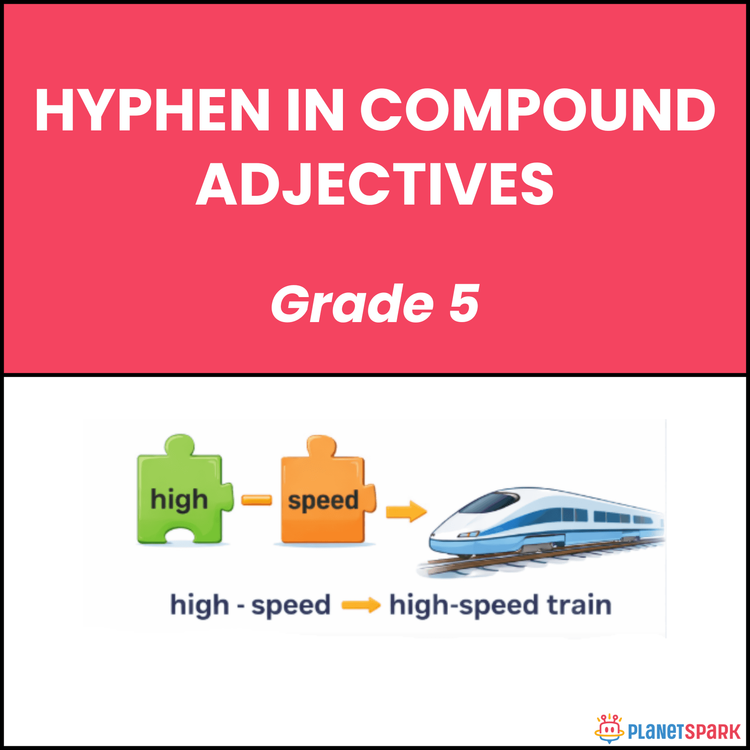
Class 5 Hyphen Adjectives Grammar Worksheet
Two Words, One Idea: Hyphenated Compound Adjectives for Class 5
This Grade 5 grammar worksheet helps students understand how to use hyphens in compound adjectives correctly. The topic “Hyphen in Compound Adjectives” teaches learners how two words can work together as a single descriptive unit to modify a noun.
Compound adjectives are commonly used in everyday English, especially when two words come together before a noun to describe it clearly. Using a hyphen between these words helps avoid confusion and makes writing more precise and organized.
Designed for Grade 5 learners, this worksheet includes engaging grammar exercises such as multiple-choice questions, true or false statements, fill-in-the-blanks, sentence rewriting, and paragraph writing. These tasks help students recognize correct hyphen usage, identify incorrect compound adjective structures, and apply the rule confidently in their own sentences.
By practicing these activities, students strengthen their grammar knowledge, improve sentence clarity, and learn how punctuation helps combine descriptive words effectively. The worksheet also encourages learners to notice how compound adjectives appear in real-world writing and everyday communication.
Why Hyphenated Compound Adjectives Matter in Grammar?
Compound adjectives combine two words to describe a noun clearly. For Grade 5 learners, this topic is important because:
1. Hyphens connect two descriptive words to act as one adjective.
2. They prevent confusion in sentence meaning.
3. They make descriptions clearer and more precise.
4. They are commonly used in both writing and spoken descriptions.
What’s Inside This Worksheet?
This worksheet includes five grammar-rich activities that build understanding of hyphenated compound adjectives:
Exercise 1 – Multiple Choice: Correct Hyphen Usage
Students choose the sentence that correctly uses a hyphen to form a compound adjective.
Exercise 2 – True or False
Learners decide whether the compound adjective in each sentence uses a hyphen correctly.
Exercise 3 – Fill in the Blanks
Students complete sentences by inserting suitable hyphenated compound adjectives.
Exercise 4 – Sentence Rewriting with Word Box
Students rewrite sentences by replacing phrases with compound adjectives from the provided word bank.
Exercise 5 – Paragraph Writing
Students read a short passage and fill the blanks with suitable compound adjectives that fit the context.
Answer Key (For Parents & Educators)
Exercise 1 – Choose the Correct Sentence
1. Rishi saw a bright-colored bird.
2. We stayed in a well-known hotel.
3. Ravi bought a second-hand cycle.
4. Meera read a long-interesting storybook.
5. It was a fast-moving train.
6. Riya made a well-planned chart.
7. He gave a last-minute answer.
8. We saw a snow-covered hill.
9. Ravi wore a bright-colored shirt.
10. They watched a high-speed train.
Exercise 2 – True or False
1. True
2. True
3. True
4. True
5. True
6. True
7. True
8. True
9. True
10. True
Exercise 3 – Fill in the Blanks (Compound Adjectives)
1. bright-colored
2. second-hand
3. well-known
4. well-planned
5. fast-moving
6. long-interesting
7. light-weight
8. snow-covered
9. high-speed
10. last-minute
Exercise 4 – Rewritten Sentences
1. Priya met a well-known singer yesterday.
2. Meera made a last-minute decision today.
3. We saw a high-speed train pass.
4. Rohan bought a second-hand cycle yesterday.
5. The hill was snow-covered.
6. The train was fast-moving today.
7. Riya wore a bright-colored dress today.
8. Ravi solved a tricky problem quickly.
9. They saw a fast-moving train.
10. The road was snow-covered.
Exercise 5 – Paragraph Writing
1. well-known
2. high-speed
3. last-minute
Help your child strengthen grammar and writing skills by mastering compound adjectives and punctuation rules with expert communication coaching.
Frequently Asked Questions
Hyphenated adjectives are two or more words joined by a hyphen that together describe a noun, such as well-known author or long-term plan. They help make descriptions clearer in sentences.
A hyphen shows that the words work together as one idea before a noun. Without the hyphen, the meaning of the sentence may become confusing for readers.
Students can practice with grammar worksheets that include identifying compound adjectives, adding hyphens, and writing sentences using these descriptive word pairs.