
Class 5 Worksheet on Editing: Pronoun–Antecedent

Class 5 Worksheet on Editing: Pronoun–Antecedent
Making Words Match: Editing Pronoun-Antecedent Agreement for Grade 5
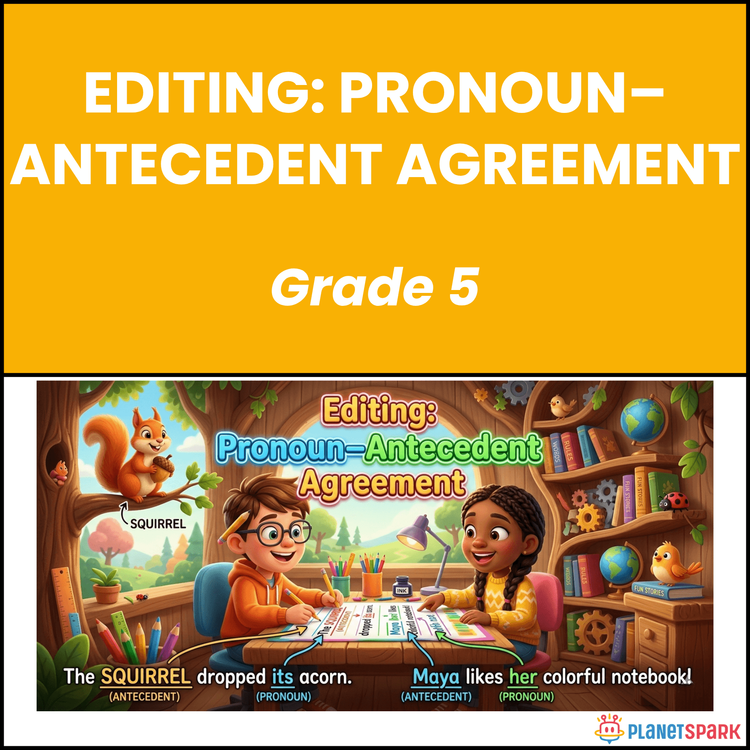
This Grade 5 worksheet focuses on the essential grammar skill of pronoun-antecedent agreement—ensuring that pronouns match the nouns they replace in number and gender. Students will learn to identify the antecedent (the word a pronoun refers to) and choose the correct pronoun that agrees with it. Through targeted practice, young learners will develop the skills needed for clear and accurate writing.
Why Mastering Pronoun-Antecedent Agreement Matters in Grammar?
For Grade 5 students, correct pronoun-antecedent agreement is fundamental to clear communication. This topic is important because:
1. It ensures that sentences are grammatically correct and easy to understand.
2. It helps readers know exactly which noun a pronoun is referring to, avoiding confusion.
3. It builds attention to detail and precision in writing.
What's Inside This Worksheet?
This worksheet includes five targeted activities to build strong agreement skills:
Exercise 1 – True or False
Students read sentences and decide if the pronoun agrees with its antecedent. This quick assessment helps identify common agreement errors.
Exercise 2 – Multiple Choice Questions
Students choose the correct pronoun that agrees with the antecedent in each sentence. This classic format reinforces agreement rules.
Exercise 3 – Fill in the Blanks
Students select the appropriate pronoun from a given pair that agrees with the antecedent. This activity encourages active application of agreement rules.
Exercise 4 – Underline and Rewrite
Each sentence in this exercise contains a pronoun-antecedent agreement error. Students must identify the error and rewrite the sentence correctly, building essential editing skills.
Exercise 5 – Paragraph Completion
This comprehensive exercise presents a paragraph about a desert safari with blanks. Students must fill in each blank with the correct pronoun that agrees with the antecedent in bold, demonstrating their mastery in a connected, real-world context.
🔹 Answer Key
Exercise 1 – True or False
1. True
2. True
3. False (My grandparents celebrated their anniversary last week.)
4. True
5. False (My cousins lost their way in the Chennai mall.)
6. False (The monsoon brought its rains to Kerala.)
7. True
8. False (Someone left their wallet at the chai stall.)
9. True
10. False (The ISRO scientists celebrated their success.)
Exercise 2 – Multiple Choice Questions
1. b) its
2. b) their
3. b) her
4. b) our
5. b) his
6. a) your
7. a) its
8. a) us
9. b) their
10. a) them
Exercise 3 – Fill in the Blanks
1. its
2. their
3. he
4. his
5. she
6. her
7. their
8. their
9. her
10. their
Exercise 4 – Underline and Rewrite
1. The worker carried his basket up the hill.
2. The tea leaves lost their freshness in the sun.
3. My mother said that she would buy organic tea.
4. Somebody left their phone in the library.
5. Every teacher submitted their reports early.
6. The team celebrated its victory with a parade. (or "their" if referring to team members)
7. The tourists enjoyed their time at the plantation.
8. The guide said that he would show the processing unit to us.
9. Nobody forgot their lines in the play.
10. Everyone carried their own water bottle.
Exercise 5 – Paragraph Completion
My cousins and I went on a desert safari in Jaisalmer. We rode camels across the golden sand. The guide warned that he would lead us before sunset. Each camel had its own bell around its neck. The tourists clicked their photographs of the dunes. My uncle said that he would try sandboarding. The wind carried its whispers across the desert. The camp set up its tents near a small oasis. Everyone gathered around their campfire at night. The stars revealed their brightness in the dark sky. We will never forget our adventure.
Help your child master pronoun-antecedent agreement and write with precision through a Free 1:1 Communication Skills Trial Class at PlanetSpark.
Frequently Asked Questions
The goal is to help students detect and correct pronouns that do not match their nouns.
They may forget whether the noun is singular or plural when choosing a pronoun.
Regular correction practice helps learners recognize agreement errors quickly.