
Class 5 Worksheet on Reflexive vs Intensive Pronouns

Class 5 Worksheet on Reflexive vs Intensive Pronouns
Two Roles, Same Words: Reflexive vs Intensive Pronouns for Grade 5
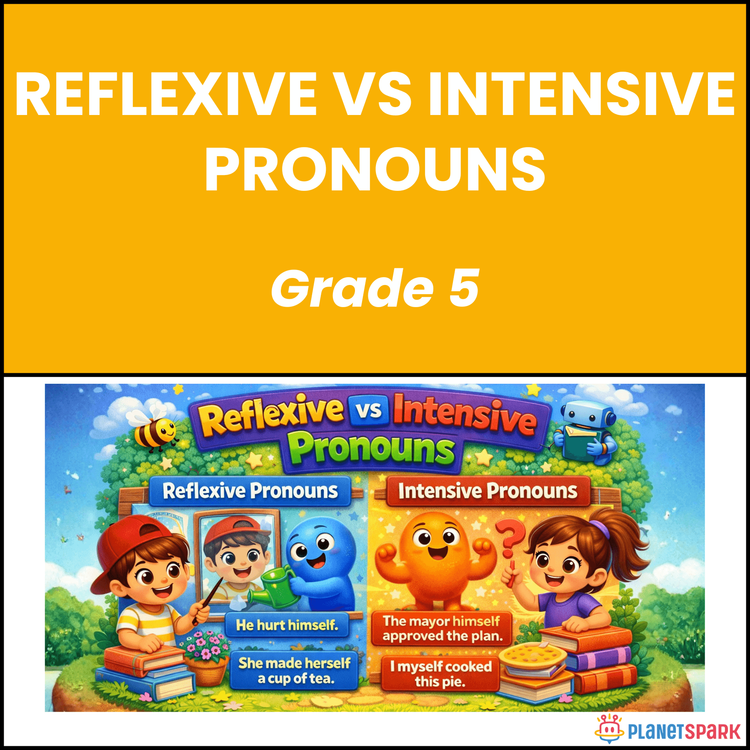
This Grade 5 worksheet helps students understand the dual role of pronouns like myself, yourself, himself, herself, itself, ourselves, and themselves. These words can function as reflexive pronouns (where the action reflects back to the subject) or intensive pronouns (where they emphasize the subject). Through engaging exercises, students will learn to distinguish between these two important uses.
Why Mastering Reflexive vs Intensive Pronouns Matters in Grammar?
For Grade 5 students, understanding the difference between reflexive and intensive pronouns adds depth to their grammar knowledge. This topic is important because:
1. It helps students recognize that the same pronoun can serve different functions in sentences.
2. It improves reading comprehension by helping students understand the role of emphasizing words.
3. It builds precision in writing by teaching when to use these pronouns correctly.
What's Inside This Worksheet?
This worksheet includes five targeted activities to build a deep understanding:
Exercise 1 – Think and Write
Students read sentences and write R if the pronoun is used as a reflexive pronoun (reflects action back to the subject) or I if it is used as an intensive pronoun (emphasizes the subject).
Exercise 2 – Multiple Choice Questions
Students choose the correct pronoun from two options to complete each sentence. This classic format reinforces proper pronoun selection.
Exercise 3 – Fill in the Blanks
Students select the appropriate reflexive or intensive pronoun from a given pair to complete each sentence. This activity encourages active application.
Exercise 4 – Underline and Rewrite
Each sentence in this exercise contains an incorrect pronoun form. Students must identify the error and rewrite the sentence correctly, building essential editing skills.
Exercise 5 – Paragraph Completion
This comprehensive exercise presents a paragraph about Riya baking a cake with blanks. Students must fill in each blank with the correct reflexive or intensive pronoun, demonstrating their mastery in a connected, real-world context.
🔹 Answer Key
Exercise 1 – Think and Write (R = Reflexive, I = Intensive)
1. R
2. I
3. R
4. I
5. R
6. I
7. R
8. I
9. R
10. I
Exercise 2 – Multiple Choice Questions
1. b) herself
2. a) themselves
3. a) myself
4. b) itself
5. a) ourselves
6. a) yourself
7. b) themselves
8. a) herself
9. a) himself
10. b) ourselves
Exercise 3 – Fill in the Blanks
1. himself
2. themselves
3. myself
4. itself
5. herself
6. yourself
7. itself
8. ourselves
9. himself
10. itself
Exercise 4 – Underline and Rewrite
1. The children enjoyed themselves at the amusement park.
2. I myself baked these cookies for everyone. (Correct)
3. The dog hurt itself while playing in the garden.
4. They built themselves a new treehouse. (Correct)
5. We ourselves completed the renovation work. (Correct)
6. You should believe in yourself more.
7. He reminded himself to bring the keys. (Correct)
8. The building itself is a historical monument.
9. You yourself can solve this puzzle easily.
10. The team members motivated themselves before the match.
Exercise 5 – Paragraph Completion
Riya decided to bake a cake for her grandmother. She prepared herself for the big task ahead. Her mother helped gather all the ingredients. Riya reminded herself to add sugar at the right time. The oven heated itself up perfectly for baking. She felt proud of herself when the cake rose nicely. Her brother Ravi helped himself to a large slice. They cleaned the kitchen themselves after baking. Their grandmother enjoyed herself every single bite. Riya promised herself to bake more often. Their father said, "You should always believe in yourself."
Help your child master reflexive and intensive pronouns and write with confidence through a Free 1:1 Communication Skills Trial Class at PlanetSpark.
Frequently Asked Questions
Reflexive pronouns reflect the action back to the subject, while intensive pronouns emphasize the subject.
Words like myself, yourself, and themselves can act as reflexive or intensive depending on the sentence.
Practice activities help learners identify the pronoun’s role and apply the correct usage.