
Class 4 Grammar Worksheet Commas Compound Sentences

Class 4 Grammar Worksheet Commas Compound Sentences
Mastering Commas in Compound Sentences for Class 4
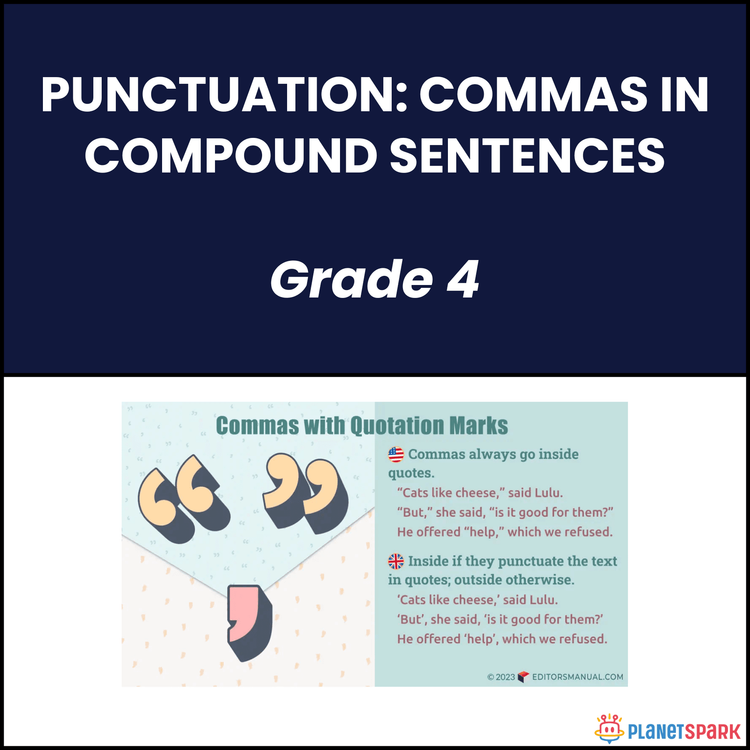
This Grade 4 worksheet helps students understand and practice the use of commas in compound sentences. Compound sentences are made by joining two independent clauses with conjunctions like *and, but, or, so,* and others. Knowing where to place commas helps students improve sentence clarity and readability.
Why Commas in Compound Sentences Matter in Grammar?
Commas in compound sentences are important because they:
1. Help break sentences into easily understandable parts.
2. Indicate where two ideas are connected by conjunctions.
3. Improve writing flow and structure by creating organized sentences.
4. Allow children to express multiple ideas clearly within one sentence.
What’s Inside This Worksheet?
This worksheet includes five engaging activities designed to practice using commas in compound sentences.
🧠 Exercise 1 – Choose the Sentence with Correct Comma Usage
Students pick the sentence with correct punctuation in compound sentences. Example: “Arjun went to the market, and he bought fresh vegetables.”
✏️ Exercise 2 – True or False
Students identify whether the comma usage in each sentence is correct in compound sentences.
📋 Exercise 3 – Fill in the Blanks
Students complete sentences by adding the correct conjunction or comma.
📝 Exercise 4 – Sentence Rewriting
Students replace incorrect words with the correct conjunctions or commas to make sentences grammatically accurate.
✍️ Exercise 5 – Complete Compound Sentences in a Passage
Students read a passage and fill in the blanks to complete compound sentences.
🔹 Answer Key (for parents and educators):
Exercise 1 – Correct Punctuation Sentences
1. b) Arjun went to the market, and he bought fresh vegetables.
2. b) He studied for the test, and then he played outside.
3. b) The teacher asked questions, but the students were silent.
4. b) The cat chased the mouse, but it couldn’t catch it.
5. b) She wanted to go swimming, but the pool was closed.
6. b) They were tired, so they took a nap.
7. b) He went to the park, and he enjoyed the beautiful weather.
8. b) The sun was shining brightly, so the picnic was enjoyable.
9. b) She likes to read books, and she also enjoys drawing.
10. b) They traveled to Delhi, and they saw many interesting places.
Exercise 2 – True or False
1. False
2. True
3. False
4. False
5. True
6. True
7. False
8. True
9. False
10. True
Exercise 3 – Fill in the Blanks (Conjunctions or Commas)
1. market, and
2. test, and
3. asked questions, but
4. mouse, but
5. swimming, but
6. tired, so
7. park, and
8. brightly, so
9. books, and
10. Delhi, and
Exercise 4 – Sentence Rewriting (Replace Incorrect Word)
1. Arjun went to the market, and he bought fresh vegetables.
2. He studied for the test, and then he played outside.
3. The teacher asked questions, and the students were silent.
4. The cat chased the mouse, but it couldn’t catch it.
5. She wanted to go swimming, but the pool was closed.
6. They were tired, so they took a nap.
Exercise 5 – Fill in the Blanks (Sample Answers)
1. because
2. and
3. and
4. but
5. so
Help your child strengthen their sentence punctuation skills today with expert-led grammar practice.
🔖Book a free trial!
Frequently Asked Questions
A comma is placed before coordinating conjunctions like and, but, or, so when joining two independent clauses.
They may forget the comma or misuse it when the second part is not a complete sentence.
It improves sentence structure and prevents run-on errors in writing.