
Class 7 Grammar Worksheet on Mixed Clauses and Conditionals Review

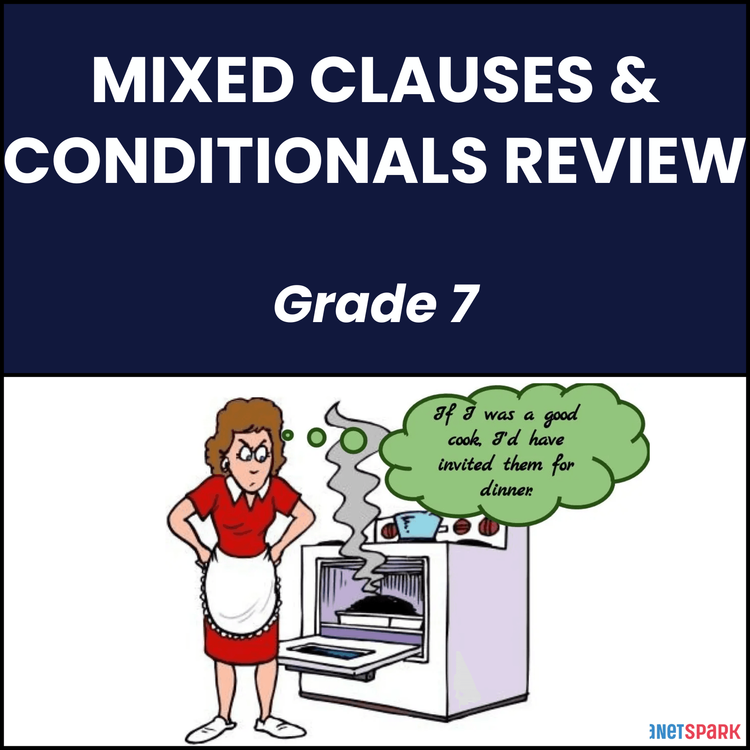
Class 7 Grammar Worksheet on Mixed Clauses and Conditionals Review
Mastering Connections: Mixed Clauses and Conditionals for Class 7
This Grade 7 worksheet is designed to help students master the complex art of connecting ideas using various types of clauses and conditional sentences. Learners will explore relative (adjective) clauses, adverbial clauses of reason, time, and contrast, as well as zero, first, and second conditional structures. Through a variety of high-engagement tasks like multiple-choice questions, true/false identification, sentence rewriting, and paragraph completion, students will build the grammatical precision needed for sophisticated writing and fluent communication.
Why Mixed Clauses & Conditionals Matter in Grammar?
Clauses and conditionals are the building blocks of complex thought expression. For Grade 7 learners, this topic is important because:
1. They allow students to combine simple ideas into nuanced, mature sentences.
2. Conditionals help in expressing hypothetical situations, scientific facts, and future possibilities.
3. Relative clauses provide essential information about subjects without starting new sentences.
4. Mastering these structures improves performance in creative writing, formal essays, and daily conversations.
What’s Inside This Worksheet?
This worksheet includes five comprehensive activities that challenge and refine a student's understanding of sentence structure:
🧠 Exercise 1 – Multiple Choice Questions
Students choose the correct relative pronoun or conditional verb form to complete sentences. Example: "The book ______ you gave me is amazing." (a) which (b) who.
✅ Exercise 2 – True or False (Conditional Logic)
Learners evaluate whether sentences use correct conditional or clause structures. This builds a critical eye for common grammatical errors in complex sentences.
✏️ Exercise 3 – Fill in the Blanks
Students identify and provide the missing link—either a conjunction (because, although) or a verb form (will, would)—to complete the logical flow of the sentence.
📋 Exercise 4 – Sentence Rewriting
A high-level task where students combine or transform sentences into specific structures like Adjective Clauses or Adverbial Clauses of Reason.
📝 Exercise 5 – Paragraph Completion
Students apply their knowledge in a holistic context by filling in a themed paragraph about health and habits with the correct mixed clauses and conditionals.
✅ Answer Key (For Parents & Educators)
Exercise No. 1
1. a) whom
2. a) which
3. b) when
4. a) If
5. a) If
6. b) boils
7. b) will
8. a) will
9. a) had
10. b) had
Exercise No. 2
1. True
2. True
3. False
4. True
5. False
6. True
7. False
8. True
9. True
10. False
Exercise No. 3
1. because
2. because
3. because
4. who
5. although
6. will
7. will
8. will
9. would
10. feel
Exercise No. 4
1. The woman who is wearing a red dress is my aunt.
2. The man who helped me with the luggage is very tall.
3. He was late for the meeting because he missed the bus.
4. The students didn't attend the lecture because they were busy with assignments.
5. If the weather is good tomorrow, I will go to the beach.
6. If I finish my work, I will go to the park.
7. If she liked pizza, she would join us for dinner.
8. If I didn't get the job, I wouldn't be able to pay rent.
9. I will write you a letter when I finish this project.
10. Although the weather was bad, she loves hiking.
Exercise No. 5
Answers may vary. (Based on worksheet flow: If, When, if/when, will, When/If, If, will, who, If, will, had).
Empower your child to write with sophistication and clarity by booking a Free 1:1 Grammar and Communication Trial at PlanetSpark today.
🔖Book a free trial!
Frequently Asked Questions
Mixed clauses combine conditional sentences with other clauses for more complex meaning.
Understanding clauses and conditionals helps students express more complex thoughts.
By combining real-world scenarios with conditional structures for clarity.