
Class 7 Worksheet on Clause Structure Review

Class 7 Worksheet on Clause Structure Review
Master Sentence Patterns: Mixed Clause & Sentence Structure Review for Class 7
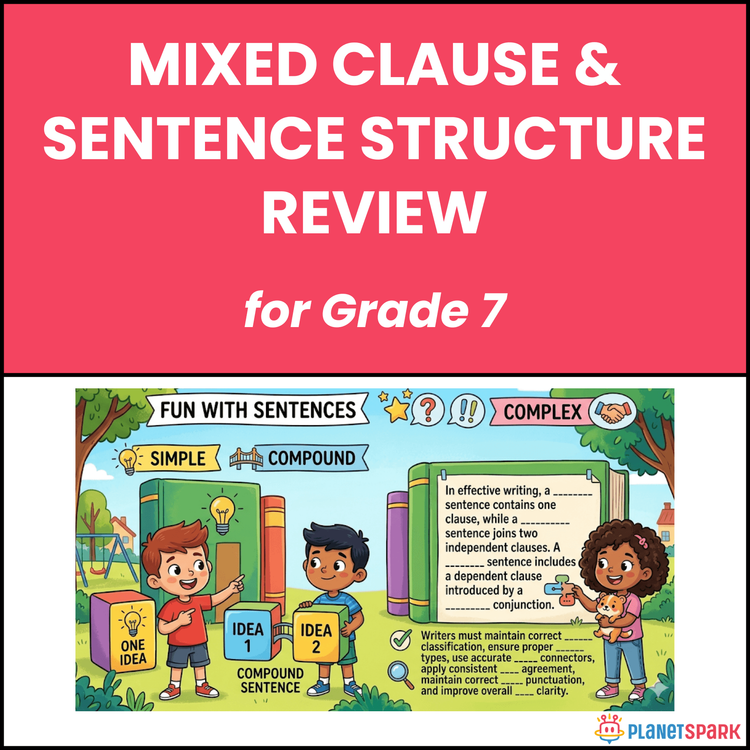
This Grade 7 worksheet on Mixed Clause & Sentence Structure Review helps students strengthen their understanding of simple, compound, and complex sentences through structured grammar practice. By identifying clauses, analyzing sentence types, and rewriting sentences using different structures, learners improve grammar accuracy, sentence fluency, and overall writing clarity.
Why Clause and Sentence Structure Matter in Grammar?
Understanding sentence structures helps students organize ideas clearly and communicate effectively. For Grade 7 learners, this topic is important because:
1. It improves sentence variety and writing flow.
2. It strengthens understanding of clauses and conjunctions.
3. It helps students distinguish between simple, compound, and complex sentences.
4. It builds stronger academic and creative writing skills.
What’s Inside This Worksheet?
Students move from identifying sentence structures to rewriting and constructing different clause patterns through guided grammar practice.
🧠 Exercise 1 – Identify Clauses and Sentence Types
Students underline sentences containing clauses and circle simple sentences to recognize different sentence structures.
✏️ Exercise 2 – Multiple Choice Questions
Students identify simple, compound, and complex sentences based on clause relationships and conjunction use.
📋 Exercise 3 – Sentence Rewriting
Students rewrite simple sentences as compound or complex sentences using conjunctions and dependent clauses.
📝 Exercise 4 – Fill in the Blanks
Students complete a grammar passage using terms related to clauses, sentence types, connectors, agreement, and punctuation.
✍️ Exercise 5 – Paragraph Writing
Students write a 6–8 sentence paragraph on “A Day When Everything Went Wrong” using simple, compound, and complex sentences. They must include at least one compound sentence and one complex sentence to demonstrate sentence structure variety.
A strong response will include examples such as “The bus arrived late, so I missed assembly.” and “Although I woke up early, I forgot my homework.”
✅ Answer Key (For Parents & Educators)
Exercise 1 – Clauses and Sentence Types
1. Simple sentence
2. Sentence with clauses
3. Simple sentence
4. Sentence with clauses
5. Sentence with clauses
6. Sentence with clauses
7. Sentence with clauses
8. Sentence with clauses
9. Simple sentence
10. Sentence with clauses
Exercise 2 – Multiple Choice Questions
1. a) The girl finished her work because she was focused.
2. b) The boy walked home, and he carried an umbrella.
3. c) The teacher spoke clearly.
4. c) The match ended because it rained.
5. c) She studied hard, so she succeeded.
6. b) The dog barked loudly.
7. c) The bus that was delayed arrived late.
8. b) He completed the task, and he submitted it.
9. a) She smiled brightly.
10. a) They left early because it was dark.
Exercise 3 – Sentence Rewriting (Sample Answers)
1. The boy runs fast, and he wins races.
2. The teacher explains clearly because students want to understand the lesson.
3. The dog barked loudly, and the guard woke up.
4. Although it was raining, the match continued.
5. She studied hard, so she scored well.
6. The bus arrived late because of heavy traffic.
7. He completed the task, and he submitted it on time.
8. They left early because it was getting dark.
9. The girl finished her work, and she rested afterward.
10. The students listened carefully because the teacher explained an important topic.
Exercise 4 – Fill in the Blanks
1. simple
2. compound
3. complex
4. subordinating
5. sentence
6. clause
7. conjunction
8. subject-verb
9. sentence
10. writing
Exercise 5 – Paragraph Writing (Sample Answer)
A Day When Everything Went Wrong
I woke up late this morning. Although I rushed to get ready, I forgot my homework at home. The bus arrived early, so I missed it completely. My friends tried to help me, and they shared their notes before class. Because I felt nervous, I could not answer the teacher’s first question properly. The lunch box also spilled inside my bag. By the end of the day, I was tired, but I learned to stay more organized.
Help your child master sentence structures and clause patterns through engaging grammar practice that builds stronger writing confidence and communication skills.
🔖Book a free trial!
Frequently Asked Questions
Clause structure refers to how subjects and verbs are arranged to form independent and dependent clauses.
It strengthens sentence formation skills and helps avoid grammatical errors in writing.
By practicing identifying and combining clauses through structured exercises.