
Class 7 English Worksheet on Argument Purpose & Form

Class 7 English Worksheet on Argument Purpose & Form
Save the Tree, Build the Argument: Argument Purpose & Form for Class 7
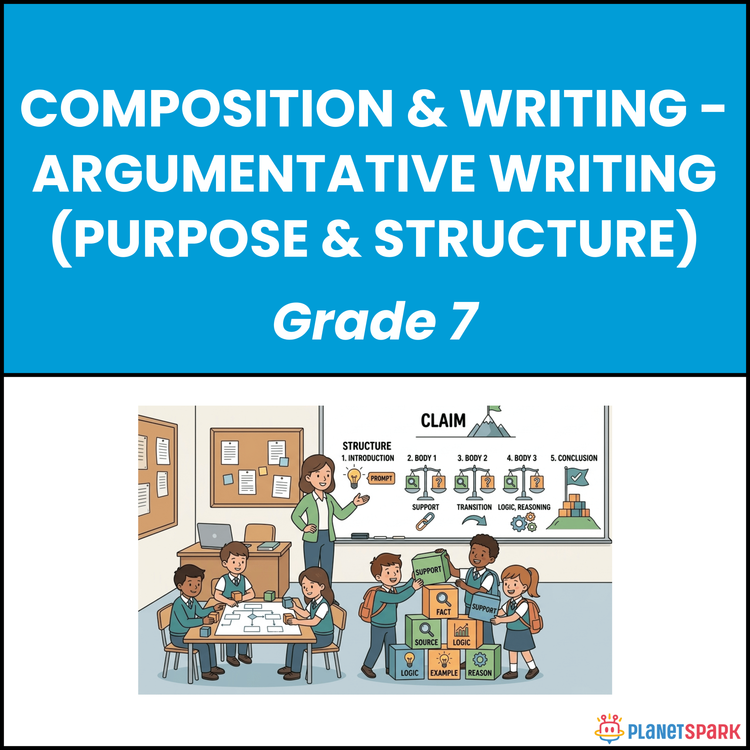
This Grade 7 worksheet introduces students to the essentials of argumentative writing through an engaging story about saving a banyan tree. It focuses on the purpose and structure of arguments—helping learners understand how to present ideas clearly, support them with evidence, and respond to opposing viewpoints.
Through a variety of interactive exercises such as multiple-choice questions, fill in the blanks, true/false statements, error identification, and paragraph completion, students strengthen their comprehension and grammar skills in a practical and meaningful way. Each task encourages learners to think critically about how arguments are formed and how language is used to persuade effectively.
Why Argument Writing Matters in Grammar?
Argumentative writing is a key skill that helps student's express opinions logically and confidently. For Grade 7 learners, this topic is important because:
1. It teaches how to make a clear claim and support it with reasons.
2. It develops the ability to use evidence to strengthen ideas.
3. It encourages understanding of different perspectives through counterarguments.
4. It builds structured communication skills useful in writing and speaking.
What’s Inside This Worksheet?
This worksheet includes five grammar-rich activities that build a strong foundation in argumentative writing:
Exercise 1 – Multiple Choice Questions
Students answer comprehension-based questions about the story, focusing on key elements like claim, evidence, and purpose.
Exercise 2 – Fill in the Blanks
Students select appropriate words such as *claim, evidence, persuade, and conclusion to complete sentences based on the story.
Exercise 3 – True or False
Students evaluate statements and decide whether they correctly reflect the story’s events and message.
Exercise 4 – Underline the Incorrect Word
Students identify and underline words that do not match the meaning or facts from the story, sharpening their attention to detail.
Exercise 5 – Paragraph Completion
Students complete a summary paragraph using key argumentative terms, reinforcing their understanding of structure and vocabulary.
Answer Key (For Parents & Educators)
Exercise 1 – Multiple Choice
1. c) To see the banyan tree with a ribbon around it
2. a) Dadi Leela
3. d) To convince people without quarrelling
4. b) The banyan tree should stay
5. a) Zoya
6. c) Answer the other side
7. b) The need for parking
8. d) The thermometer reading
9. a) Along the east wall
10. b) A clear argument with reasons and evidence
Exercise 2 – Fill in the Blanks
1. claim
2. persuade
3. evidence
4. thermometer
5. sheltered
6. credible
7. alternative
8. committee
9. conclusion
10. truth
Exercise 3 – True / False
1. True
2. True
3. False
4. True
5. False
6. False
7. True
8. True
9. True
10. False
Exercise 4 – Underline the Incorrect Word
1. confuse → persuade
2. rumours → evidence
3. children → community
4. hotter → cooler
5. obstacle → alternative
6. illogical → practical
7. general grocer → fruit seller
8. quarrel → convince
9. ignored → addressed
10. silent → noisy
Exercise 5 – Paragraph Completion
1. moment
2. claim
3. reasons
4. evidence
5. counterargument
6. alternative
7. convincing
8. community
9. conclusion
10. truth
Help your child become a confident speaker and logical thinker by mastering argument writing skills with expert guidance.
Frequently Asked Questions
The purpose of an argument is to present a clear opinion or claim and support it with reasons and evidence.
Students often state opinions without proper reasons or skip structure, which weakens clarity and effectiveness in their english writing.
Purpose refers to why the argument is written, while form refers to how it is structured and presented.