
Class 3 Grammar Worksheet on Active vs Passive Voice

Class 3 Grammar Worksheet on Active vs Passive Voice
Active vs Passive Voice (Intro) - Grade 3
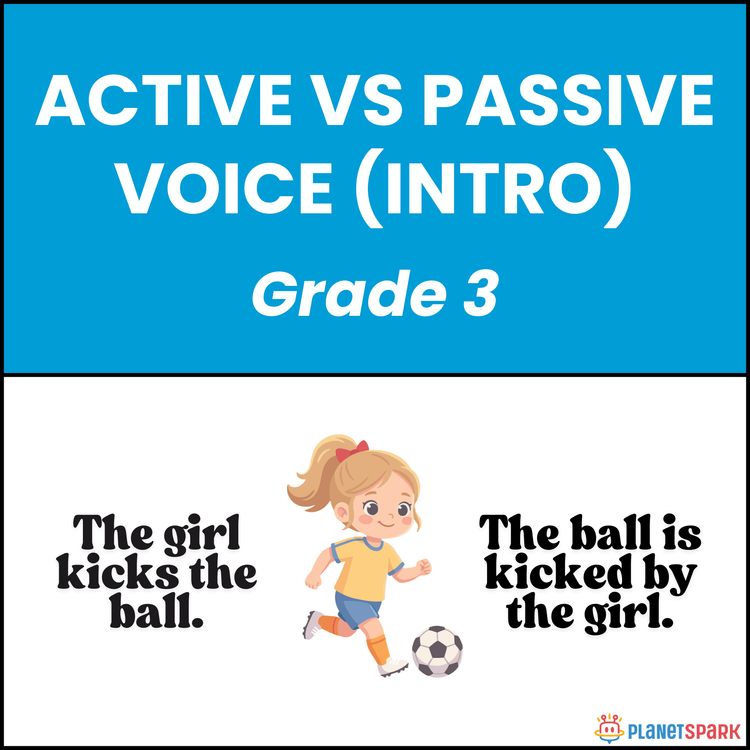
Understanding the difference between active and passive voice is fundamental to improving grammar and sentence structure. In active voice, the subject of the sentence performs the action, while in passive voice, the subject receives the action. This worksheet will help Grade 3 students recognize and practice both types of voice, ensuring a strong foundation for more complex grammar topics in the future.
Why Active vs Passive Voice Matters in Grammar?
Active and passive voice help students understand how sentences are structured in English:
1. Learning to switch between them improves clarity, enhances sentence variety, and strengthens writing skills.
2. Active voice is often clearer and more direct, while passive voice is useful when the focus is on the action or the object.
3. Active voice makes sentences clearer, and passive voice allows us to focus on the action or object.
4. It helps improve sentence structure, comprehension, and flexibility in writing and speaking.
What’s Inside This Worksheet?
This Grade 3 worksheet introduces the concept of Active vs Passive Voice through fun and engaging activities. It includes:
Exercise 1 – Underline the passive voice sentences.
Students are asked to underline the sentence that is written in the passive voice.
Exercise 2 – Identify the correct sentence based on the voice (active or passive).
In each question, students are given three sentences, and they must choose the correct sentence based on the voice (active or passive).
Exercise 3 – Rewrite sentences by changing the voice.
In this exercise, students are given a list of sentences and are asked to rewrite them in the opposite voice.
Exercise 4 – Fill in the blanks with suitable words to form passive voice sentences.
The students will choose between the active and passive form of the verb (e.g., “kicked” vs “was kicked”) to complete each sentence correctly.
Exercise 5 – Write a short paragraph on "My Study Room" using the correct voice.
Students are asked to write a short paragraph about their study room, using both active and passive voice in their sentences.
These activities are designed to make the learning process both enjoyable and effective, ensuring a strong foundation in understanding how active and passive voice are used in real-life contexts.
Answer Key (For Parents and Educators)
Exercise 1 – Underlined Passive Voice Sentences:
1. Rangoli was drawn by Riya.
2. The bottle was opened by Aarav.
3. Tulips are sown by Amit.
4. The cream is spread by Meenu.
5. The table is cleaned by Geeta.
6. Jasmine was planted by the gardener.
7. The clay pot was filled by the mother.
8. The peacock is painted by Pooja.
9. The lantern was carried by Tara.
10. The clothes were folded by Anu. .
Exercise 2 – Identify Passive/Active Voice:
1. b)
2. b)
3. c)
4. a)
5. c)
6. a)
7. b)
8. c)
9. b)
10. a)
Exercise 3 – Sentence Rewriting:
1. The mouse is chased by the cat.
2. Breakfast was eaten quickly by Tara.
3. The bees made the honey.
4. Anjali read the book.
5. The cookies are baked by the chef.
6. The gardener watered the plants.
7. The grass was soaked by the rain.
8. Sara brushed her hair.
9. The mail was delivered by the mailman.
10. Tara caught the ball.
Exercise 4 – Fill in the Blanks:
1. was kicked
2. was spread
3. unpacked
4. was carried
5. was blown
6. jumped
7. was made
8. cheered
9. was remembered
Exercise 5 - Paragraph Writing
Answers may vary.
Help your child master the concept of Active and Passive Voice today with a Free 1:1 Grammar Skills Trial Class at PlanetSpark.
Frequently Asked Questions
Active voice focuses on the subject performing the action, while passive voice focuses on the action being done to the subject.
It is useful when the action or object is more important than the subject.
Through sentence transformation exercises, where they switch between both voices.